Use your browser’s Find (Ctrl+F / ⌘F) to locate a setting. Open its row for the full explanation and limits. Source-check time is a verification timestamp, not a script publication date.
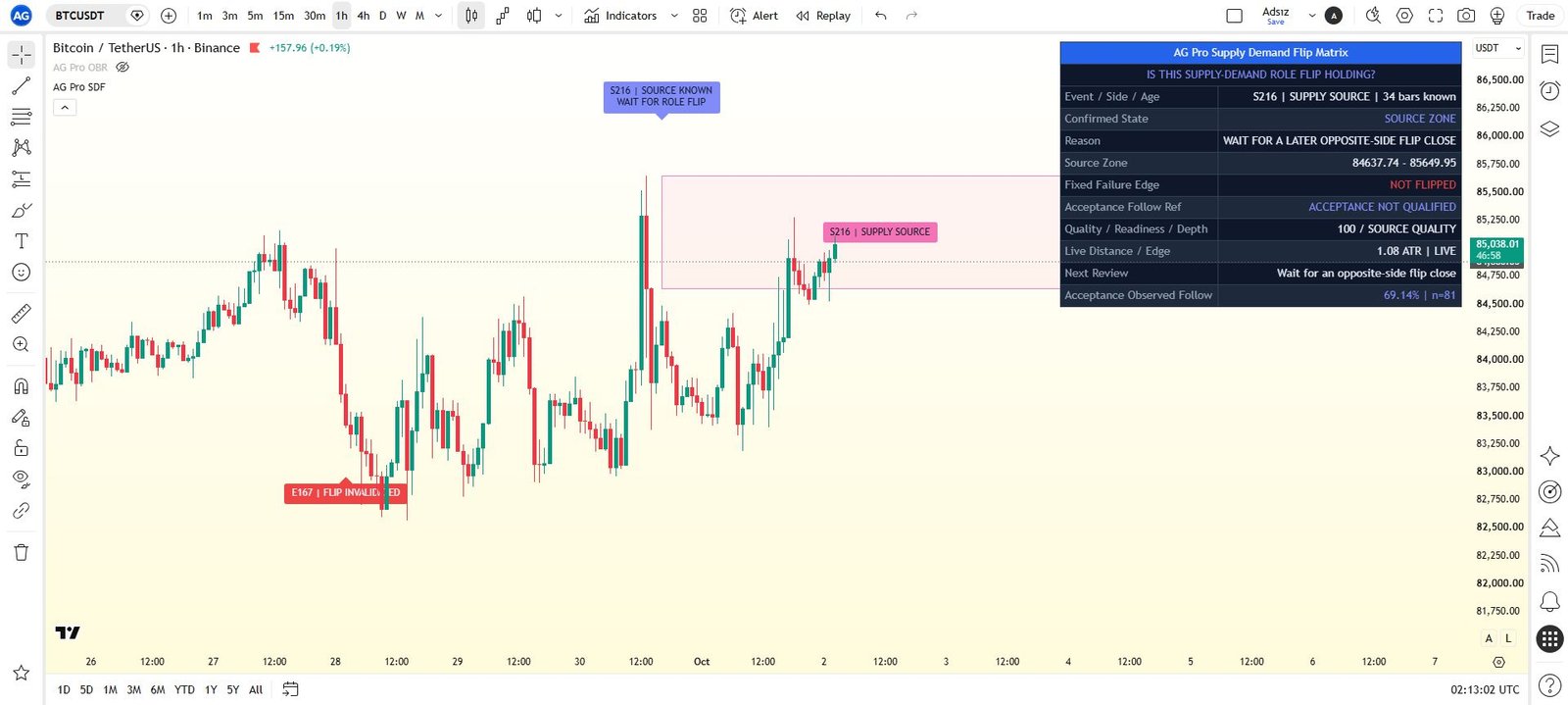
General settings
27 inputsFlip Mode
- Input type
string- Source default
"Auto"- Available options
["Auto", "Supply Focus", "Demand Focus"]- Minimum
Not specified in source- Maximum
Not specified in source- Step
Not specified in source
What it controls
Controls which side of the supply-demand flip workflow is allowed to evaluate.
Effect on the script
Auto evaluates both source types using the selected active-zone ownership policy. Supply Focus tracks original supply sources; Demand Focus tracks original demand sources.
When to adjust it
Change it only when the specific analytical or presentation question in the tooltip changes.
Interpretation and limits
Record the configuration when comparing observations; a changed setting is not proof of a stronger future result.
Original input tooltip
Controls which side of the supply-demand flip workflow is allowed to evaluate. Auto evaluates both source types using the selected active-zone ownership policy. Supply Focus tracks original supply sources; Demand Focus tracks original demand sources.
Lookback
- Input type
int- Source default
50- Available options
Not specified in source- Minimum
20- Maximum
300- Step
Not specified in source
What it controls
Controls the baseline window for displacement, body size, and volatility measurements.
Effect on the script
Changes the measurement horizon used by the oscillator, trend, range, or context component named by the setting.
When to adjust it
Change it when comparing a different analytical horizon and record the configuration alongside the observations.
Interpretation and limits
Different windows produce different contexts and are not evidence of an improved future result.
Original input tooltip
Controls the baseline window for displacement, body size, and volatility measurements.
Pivot Context
- Input type
int- Source default
3- Available options
Not specified in source- Minimum
2- Maximum
10- Step
Not specified in source
What it controls
Controls the local swing context used to qualify supply and demand source zones.
Effect on the script
Changes the confirmed-pivot qualification or separation requirement specified by the control.
When to adjust it
Adjust it when studying a different structural scale or the spacing allowed between compared pivots.
Interpretation and limits
Confirmed pivots require later information; a displayed historical pivot was not necessarily known at its own bar.
Original input tooltip
Controls the local swing context used to qualify supply and demand source zones.
Flip Sensitivity
- Input type
string- Source default
"Balanced"- Available options
["Relaxed", "Balanced", "Strict"]- Minimum
Not specified in source- Maximum
Not specified in source- Step
Not specified in source
What it controls
Controls how strict the source-zone qualification should be.
Effect on the script
Strict mode requires cleaner displacement and stronger pivot context.
When to adjust it
Compare requirements under a fixed symbol, timeframe, and remaining configuration.
Interpretation and limits
A more selective or stronger heuristic score is not a calibrated success probability or a guarantee of reversal or continuation.
Original input tooltip
Controls how strict the source-zone qualification should be. Strict mode requires cleaner displacement and stronger pivot context.
Zone Width Model
- Input type
string- Source default
"Body + Wick"- Available options
["Body", "Body + Wick", "ATR-Padded"]- Minimum
Not specified in source- Maximum
Not specified in source- Step
Not specified in source
What it controls
Controls how the active zone is built from the source candle.
Effect on the script
Body is compact, Body + Wick is broader, and ATR-Padded adds volatility padding.
When to adjust it
Adjust it when deliberately comparing a narrower or broader structural review definition.
Interpretation and limits
A wider area or larger allowed distance does not make the context more reliable or guarantee containment.
Original input tooltip
Controls how the active zone is built from the source candle. Body is compact, Body + Wick is broader, and ATR-Padded adds volatility padding.
Acceptance Strictness
- Input type
string- Source default
"Balanced"- Available options
["Relaxed", "Balanced", "Strict"]- Minimum
Not specified in source- Maximum
Not specified in source- Step
Not specified in source
What it controls
Controls how much confirmation is required before the script treats a role flip as accepted.
Effect on the script
Changes the threshold or sensitivity of the documented qualification or review component.
When to adjust it
Compare requirements under a fixed symbol, timeframe, and remaining configuration.
Interpretation and limits
A more selective or stronger heuristic score is not a calibrated success probability or a guarantee of reversal or continuation.
Original input tooltip
Controls how much confirmation is required before the script treats a role flip as accepted.
Rejection Strictness
- Input type
string- Source default
"Balanced"- Available options
["Relaxed", "Balanced", "Strict"]- Minimum
Not specified in source- Maximum
Not specified in source- Step
Not specified in source
What it controls
Controls how quickly rejection pressure increases when price returns through the flipped zone.
Effect on the script
Changes the threshold or sensitivity of the documented qualification or review component.
When to adjust it
Compare requirements under a fixed symbol, timeframe, and remaining configuration.
Interpretation and limits
A more selective or stronger heuristic score is not a calibrated success probability or a guarantee of reversal or continuation.
Original input tooltip
Controls how quickly rejection pressure increases when price returns through the flipped zone.
Follow Target (ATR)
- Input type
float- Source default
1.0- Available options
Not specified in source- Minimum
0.5- Maximum
4.0- Step
0.25
What it controls
Defines the follow-through target, measured from the corresponding flip or acceptance confirmation close in frozen source-ATR units.
Effect on the script
This affects the historical Flip Follow Rate only.
When to adjust it
Adjust it only when deliberately changing the descriptive follow-through question being measured.
Interpretation and limits
A reference touch is an OHLC observation, not an executed target, fill, realized profit, or forecast.
Original input tooltip
Defines the follow-through target, measured from the corresponding flip or acceptance confirmation close in frozen source-ATR units. This affects the historical Flip Follow Rate only.
Follow Window (Bars)
- Input type
int- Source default
200- Available options
Not specified in source- Minimum
20- Maximum
800- Step
Not specified in source
What it controls
Defines how many completed bars a registered flip may take to reach its follow-through target before observation expiry.
Effect on the script
The final eligible completed candle is evaluated before timeout.
When to adjust it
Change it when studying another explicitly defined event or observation horizon.
Interpretation and limits
A different window changes eligibility, timeouts, or completed observations. Pending and excluded cases must remain distinct from resolved results.
Original input tooltip
Defines how many completed bars a registered flip may take to reach its follow-through target before observation expiry. The final eligible completed candle is evaluated before timeout.
Minimum Label Score
- Input type
int- Source default
75- Available options
Not specified in source- Minimum
60- Maximum
95- Step
Not specified in source
What it controls
Hides chart event labels below this score while keeping the internal workflow, panel, and alerts active.
Effect on the script
Applies the selected minimum-score filter to the documented secondary or historical labels.
When to adjust it
Adjust it when lower-priority annotations compete with the current chart context.
Interpretation and limits
A filtered label is not a removed historical outcome. Follow the tooltip for any milestones that bypass the filter.
Original input tooltip
Hides chart event labels below this score while keeping the internal workflow, panel, and alerts active.
Zone Projection Bars
- Input type
int- Source default
52- Available options
Not specified in source- Minimum
20- Maximum
250- Step
Not specified in source
What it controls
Controls how far the active supply-demand flip zone is projected to the right.
Effect on the script
Controls the horizontal extent or placement of the relevant chart drawing in bars.
When to adjust it
Adjust it when the available forward chart space or the intended visual review area changes.
Interpretation and limits
Drawing farther to the right does not extend event validity or establish that price will reach a reference.
Original input tooltip
Controls how far the active supply-demand flip zone is projected to the right.
Visual Preset
- Input type
string- Source default
"Balanced"- Available options
["Clean", "Balanced", "Rich"]- Minimum
Not specified in source- Maximum
Not specified in source- Step
Not specified in source
What it controls
Controls chart annotation density.
Effect on the script
Balanced keeps the active zone readable while limiting historical label clutter.
When to adjust it
Use a calmer preset when annotations obscure current structure, or a richer one when reviewing the documented historical context.
Interpretation and limits
More visible labels do not mean more independent evidence, trades, or profitable opportunities.
Original input tooltip
Controls chart annotation density. Balanced keeps the active zone readable while limiting historical label clutter.
State Label Cooldown
- Input type
int- Source default
55- Available options
Not specified in source- Minimum
50- Maximum
180- Step
Not specified in source
What it controls
Controls the minimum number of bars between historical state labels.
Effect on the script
Changes the spacing or acceptance cooldown described by the control; the tooltip identifies which events it affects.
When to adjust it
Adjust only after distinguishing display-label spacing from a cooldown that changes accepted-event selection.
Interpretation and limits
A selection cooldown can change the sample. Display spacing alone must not be interpreted as better analytical performance.
Original input tooltip
Controls the minimum number of bars between historical state labels.
Label Font Size
- Input type
string- Source default
"Normal"- Available options
["Small", "Normal", "Large"]- Minimum
Not specified in source- Maximum
Not specified in source- Step
Not specified in source
What it controls
Controls visible chart label size.
Effect on the script
Controls the text-size mapping used by the relevant panel or chart-label renderer.
When to adjust it
Adjust it for the chart size and viewing distance while preserving readable boundaries and state information.
Interpretation and limits
A larger font can increase chart overlap. Text size does not change the analytical observations.
Original input tooltip
Controls visible chart label size.
Source Zone Lifetime (Bars)
- Input type
int- Source default
200- Available options
Not specified in source- Minimum
10- Maximum
1000- Step
Not specified in source
What it controls
Maximum completed bars from the time the pivot source becomes known to its first opposite-side flip.
Effect on the script
Expired sources cannot replay.
When to adjust it
Change it when studying another explicitly defined event or observation horizon.
Interpretation and limits
Expired sources cannot replay.
Original input tooltip
Maximum completed bars from the time the pivot source becomes known to its first opposite-side flip. Expired sources cannot replay.
Flip Lifetime (Bars)
- Input type
int- Source default
200- Available options
Not specified in source- Minimum
10- Maximum
1000- Step
Not specified in source
What it controls
Hard lifetime from flip confirmation.
Effect on the script
Invalidated, expired and resolved flips cannot reactivate.
When to adjust it
Change it when studying another explicitly defined event or observation horizon.
Interpretation and limits
Invalidated, expired and resolved flips cannot reactivate.
Original input tooltip
Hard lifetime from flip confirmation. Invalidated, expired and resolved flips cannot reactivate.
Acceptance Qualification Deadline (Bars)
- Input type
int- Source default
80- Available options
Not specified in source- Minimum
3- Maximum
1000- Step
Not specified in source
What it controls
Later retest acceptance must qualify before this deadline from flip confirmation.
Effect on the script
The flip lifetime remains the hard cap.
When to adjust it
Change it when studying another explicitly defined event or observation horizon.
Interpretation and limits
A different window changes eligibility, timeouts, or completed observations. Pending and excluded cases must remain distinct from resolved results.
Original input tooltip
Later retest acceptance must qualify before this deadline from flip confirmation. The flip lifetime remains the hard cap.
Later Acceptance Holding Closes
- Input type
int- Source default
2- Available options
Not specified in source- Minimum
1- Maximum
5- Step
Not specified in source
What it controls
Requires consecutive closes beyond the proximal acceptance edge after the first touch.
Effect on the script
Neither creation nor first touch can confirm itself.
When to adjust it
Compare requirements under a fixed symbol, timeframe, and remaining configuration.
Interpretation and limits
A more selective or stronger heuristic score is not a calibrated success probability or a guarantee of reversal or continuation.
Original input tooltip
Requires consecutive closes beyond the proximal acceptance edge after the first touch. Neither creation nor first touch can confirm itself.
Minimum Acceptance Reaction (Anchor ATR)
- Input type
float- Source default
0.1- Available options
Not specified in source- Minimum
0- Maximum
2- Step
0.05
What it controls
Requires directional movement from first-touch close, plus quality/readiness gates and no distal failure-edge wick.
Effect on the script
Applies this parameter to the component and behavior stated in its source tooltip.
When to adjust it
Change it only when the specific analytical or presentation question in the tooltip changes.
Interpretation and limits
Record the configuration when comparing observations; a changed setting is not proof of a stronger future result.
Original input tooltip
Requires directional movement from first-touch close, plus quality/readiness gates and no distal failure-edge wick.
Acceptance Reach (Anchor ATR)
- Input type
float- Source default
3- Available options
Not specified in source- Minimum
0.5- Maximum
10- Step
0.25
What it controls
Maximum distance from the fixed acceptance boundary for initial qualification.
Effect on the script
Distant flipped zones retain deadlines.
When to adjust it
Adjust it when deliberately comparing a narrower or broader structural review definition.
Interpretation and limits
A wider area or larger allowed distance does not make the context more reliable or guarantee containment.
Original input tooltip
Maximum distance from the fixed acceptance boundary for initial qualification. Distant flipped zones retain deadlines.
Accepted Flip Cooldown (Bars)
- Input type
int- Source default
8- Available options
Not specified in source- Minimum
0- Maximum
100- Step
Not specified in source
What it controls
Spaces accepted flips.
Effect on the script
Suppressed source identities are consumed so the same pivot zone cannot replay.
When to adjust it
Adjust only after distinguishing display-label spacing from a cooldown that changes accepted-event selection.
Interpretation and limits
Suppressed source identities are consumed so the same pivot zone cannot replay.
Original input tooltip
Spaces accepted flips. Suppressed source identities are consumed so the same pivot zone cannot replay.
Active Zone Policy
- Input type
string- Source default
"Keep Until Terminal"- Available options
["Keep Until Terminal", "Replace on New Zone"]- Minimum
Not specified in source- Maximum
Not specified in source- Step
Not specified in source
What it controls
Keep retains the current source until flip or expiry, then its flipped-zone owner until closure.
Effect on the script
Replace audits pending observations and explicitly supersedes the previous owner. Policy affects sample selection.
When to adjust it
Change it only when deliberately comparing event-retention and replacement rules.
Interpretation and limits
Replacement changes sample selection and pending-observation accounting; compare results under the same policy.
Original input tooltip
Keep retains the current source until flip or expiry, then its flipped-zone owner until closure. Replace audits pending observations and explicitly supersedes the previous owner. Policy affects sample selection.
Panel Detail
- Input type
string- Source default
"Compact"- Available options
["Compact", "Full"]- Minimum
Not specified in source- Maximum
Not specified in source- Step
Not specified in source
What it controls
Compact prioritizes last confirmed state, fixed boundaries and live distance.
Effect on the script
Full adds source identity, holding evidence and observation audits.
When to adjust it
Use the current-state view for orientation and the available evidence/audit view when checking observation provenance and exclusions.
Interpretation and limits
A compact or hidden view does not remove the limitations of the underlying observations.
Original input tooltip
Compact prioritizes last confirmed state, fixed boundaries and live distance. Full adds source identity, holding evidence and observation audits.
Show Panel
- Input type
bool- Source default
true- Available options
Not specified in source- Minimum
Not specified in source- Maximum
Not specified in source- Step
Not specified in source
What it controls
Shows or hides the AGPro workflow panel.
Effect on the script
The panel summarizes zone side, flip state, acceptance, rejection, invalidation, flip score, bars active, observed flip follow rate, its descriptive one-sided 90% Wilson lower bound, setup quality, and the current analytical review.
When to adjust it
Show the panel to inspect the state and evidence, or hide it when chart space is the immediate priority.
Interpretation and limits
Hiding the panel is a presentation choice; do not treat missing rows as missing risk.
Original input tooltip
Shows or hides the AGPro workflow panel. The panel summarizes zone side, flip state, acceptance, rejection, invalidation, flip score, bars active, observed flip follow rate, its descriptive one-sided 90% Wilson lower bound, setup quality, and the current analytical review.
Panel Location
- Input type
string- Source default
"Top Right"- Available options
["Top Right", "Top Left", "Bottom Right", "Bottom Left"]- Minimum
Not specified in source- Maximum
Not specified in source- Step
Not specified in source
What it controls
Selects where the workflow panel is placed on the chart.
Effect on the script
Selects the table position used by the panel renderer.
When to adjust it
Move the panel when it overlaps active candles, the current workflow zone, or reference labels.
Interpretation and limits
Panel placement changes presentation, not the detected context or observation accounting.
Panel Theme
- Input type
string- Source default
"Dark"- Available options
["Dark", "Light"]- Minimum
Not specified in source- Maximum
Not specified in source- Step
Not specified in source
What it controls
Selects the available panel contrast theme.
Effect on the script
Selects the panel background, border, and text color scheme used for contrast.
When to adjust it
Choose the available theme that keeps the panel readable against the chart background.
Interpretation and limits
A theme changes appearance; it does not change event qualification or statistical evidence.
Panel Font Size
- Input type
string- Source default
"Normal"- Available options
["Small", "Normal", "Large"]- Minimum
Not specified in source- Maximum
Not specified in source- Step
Not specified in source
What it controls
Controls the text size for panel font size.
Effect on the script
Controls the text-size mapping used by the relevant panel or chart-label renderer.
When to adjust it
Adjust it for the chart size and viewing distance while preserving readable boundaries and state information.
Interpretation and limits
A larger font can increase chart overlap. Text size does not change the analytical observations.
Keep the settings in context
Change one analytical assumption at a time and compare the same instrument, timeframe and history. A chart reference, score, observation rate or input default does not establish a trade fill, a forward probability or a guaranteed outcome.
Return to the product overview · View this script on TradingView