Use your browser’s Find (Ctrl+F / ⌘F) to locate a setting. Open its row for the full explanation and limits. Source-check time is a verification timestamp, not a script publication date.
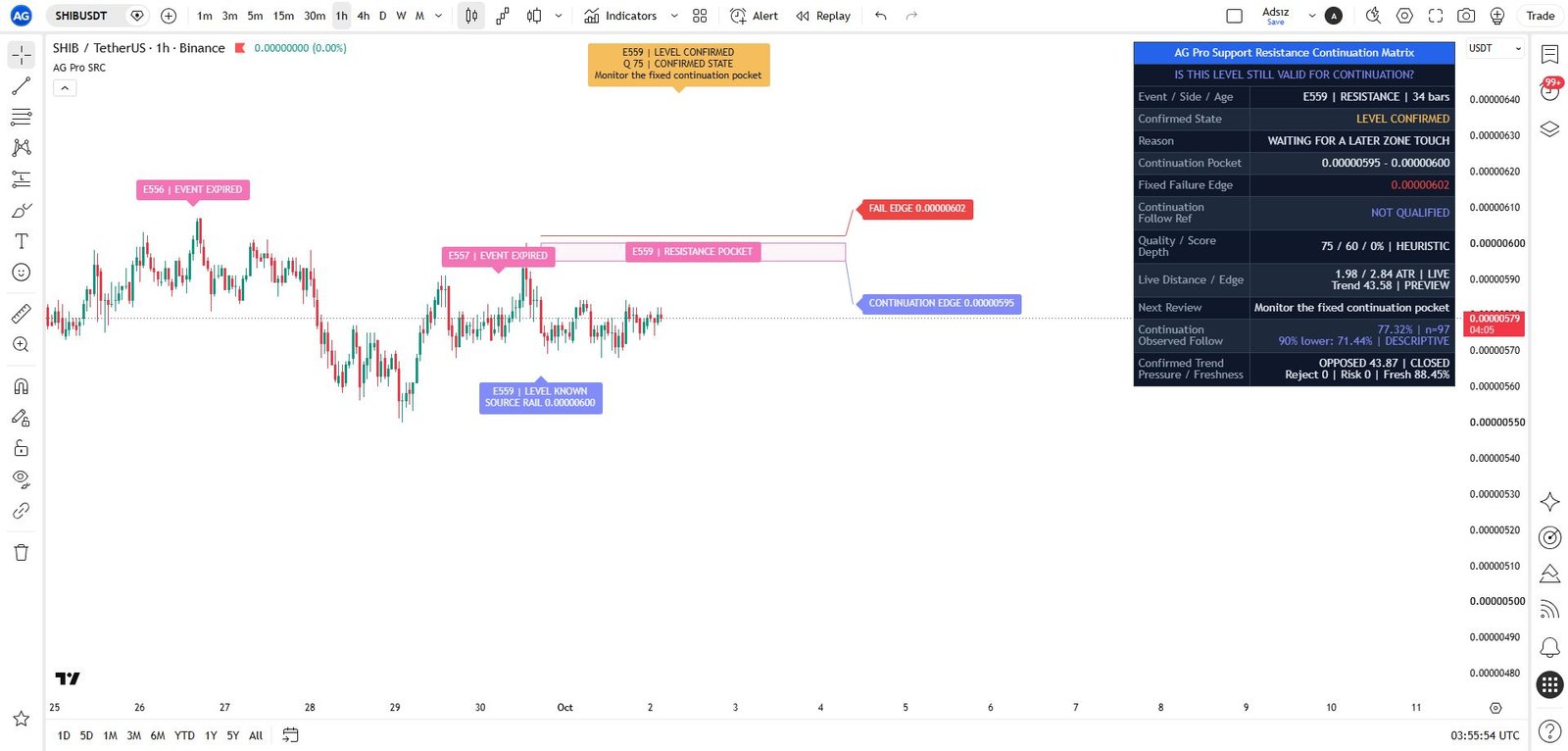
Continuation Engine
6 inputsPlanner Mode
- Input type
string- Source default
"Auto"- Available options
["Auto", "Support Continuation", "Resistance Continuation"]- Minimum
Not specified in source- Maximum
Not specified in source- Step
Not specified in source
What it controls
Auto considers both confirmed pivot sides.
Effect on the script
Directional modes restrict accepted support or resistance contexts. This engine evaluates level continuation, not a role-flip or order-block setup.
When to adjust it
Select a side only when the chart study is deliberately restricted to that scenario.
Interpretation and limits
This engine evaluates level continuation, not a role-flip or order-block setup.
Original input tooltip
Auto considers both confirmed pivot sides. Directional modes restrict accepted support or resistance contexts. This engine evaluates level continuation, not a role-flip or order-block setup.
Pivot Confirmation
- Input type
int- Source default
4- Available options
Not specified in source- Minimum
2- Maximum
12- Step
Not specified in source
What it controls
Bars on each side required to confirm a local price pivot.
Effect on the script
The rail becomes known only at the confirmation close; its pocket is not backdated to the pivot.
When to adjust it
Adjust it when studying a different structural scale or the spacing allowed between compared pivots.
Interpretation and limits
The rail becomes known only at the confirmation close; its pocket is not backdated to the pivot.
Original input tooltip
Bars on each side required to confirm a local price pivot. The rail becomes known only at the confirmation close; its pocket is not backdated to the pivot.
Structure Lookback
- Input type
int- Source default
38- Available options
Not specified in source- Minimum
12- Maximum
180- Step
Not specified in source
What it controls
Window for average candle body size.
Effect on the script
EMA 13/34 alignment and five-bar fast-EMA slope provide directional trend context.
When to adjust it
Change it when comparing a different analytical horizon and record the configuration alongside the observations.
Interpretation and limits
Different windows produce different contexts and are not evidence of an improved future result.
Original input tooltip
Window for average candle body size. EMA 13/34 alignment and five-bar fast-EMA slope provide directional trend context.
Continuation Pocket Width
- Input type
string- Source default
"Balanced"- Available options
["Tight", "Balanced", "Wide"]- Minimum
Not specified in source- Maximum
Not specified in source- Step
Not specified in source
What it controls
Fixed one-sided pocket depth from the confirmed pivot: 0.42, 0.62 or 0.86 source ATR.
Effect on the script
Geometry does not move after acceptance.
When to adjust it
Adjust it when deliberately comparing a narrower or broader structural review definition.
Interpretation and limits
Geometry does not move after acceptance.
Original input tooltip
Fixed one-sided pocket depth from the confirmed pivot: 0.42, 0.62 or 0.86 source ATR. Geometry does not move after acceptance.
Continuation Strictness
- Input type
string- Source default
"Balanced"- Available options
["Relaxed", "Balanced", "Strict"]- Minimum
Not specified in source- Maximum
Not specified in source- Step
Not specified in source
What it controls
Adjusts the directional distance contribution to the continuation score.
Effect on the script
Strict requires more progress for the same contribution; later contact and consecutive closes remain mandatory.
When to adjust it
Compare requirements under a fixed symbol, timeframe, and remaining configuration.
Interpretation and limits
A more selective or stronger heuristic score is not a calibrated success probability or a guarantee of reversal or continuation.
Original input tooltip
Adjusts the directional distance contribution to the continuation score. Strict requires more progress for the same contribution; later contact and consecutive closes remain mandatory.
Failure Risk Strictness
- Input type
string- Source default
"Balanced"- Available options
["Relaxed", "Balanced", "Strict"]- Minimum
Not specified in source- Maximum
Not specified in source- Step
Not specified in source
What it controls
Adjusts the heuristic pressure from wicks crossing the fixed failure edge.
Effect on the script
It does not move that edge or delay a completed failure close.
When to adjust it
Compare requirements under a fixed symbol, timeframe, and remaining configuration.
Interpretation and limits
It does not move that edge or delay a completed failure close.
Original input tooltip
Adjusts the heuristic pressure from wicks crossing the fixed failure edge. It does not move that edge or delay a completed failure close.
Lifecycle
8 inputsLevel Lifetime (Bars)
- Input type
int- Source default
200- Available options
Not specified in source- Minimum
20- Maximum
800- Step
Not specified in source
What it controls
Hard lifetime from knowledge time.
Effect on the script
Failed, expired and resolved levels cannot reactivate. This limit caps observation windows as well.
When to adjust it
Change it when studying another explicitly defined event or observation horizon.
Interpretation and limits
Failed, expired and resolved levels cannot reactivate.
Original input tooltip
Hard lifetime from knowledge time. Failed, expired and resolved levels cannot reactivate. This limit caps observation windows as well.
Continuation Qualification Deadline
- Input type
int- Source default
80- Available options
Not specified in source- Minimum
5- Maximum
300- Step
Not specified in source
What it controls
Maximum age for initial qualification after a later touch.
Effect on the script
The hard level lifetime takes precedence.
When to adjust it
Change it when studying another explicitly defined event or observation horizon.
Interpretation and limits
A different window changes eligibility, timeouts, or completed observations. Pending and excluded cases must remain distinct from resolved results.
Original input tooltip
Maximum age for initial qualification after a later touch. The hard level lifetime takes precedence.
Later Continuation Closes
- Input type
int- Source default
2- Available options
Not specified in source- Minimum
1- Maximum
5- Step
Not specified in source
What it controls
Consecutive later closes beyond the pocket edge with directional EMA 13/34 alignment and minimum reaction.
Effect on the script
Creation and first touch cannot self-confirm.
When to adjust it
Compare requirements under a fixed symbol, timeframe, and remaining configuration.
Interpretation and limits
Creation and first touch cannot self-confirm.
Original input tooltip
Consecutive later closes beyond the pocket edge with directional EMA 13/34 alignment and minimum reaction. Creation and first touch cannot self-confirm.
Minimum Reaction (Source ATR)
- Input type
float- Source default
0.1- Available options
Not specified in source- Minimum
0- Maximum
2- Step
0.05
What it controls
Directional movement from the first later contact close, measured using the fixed pivot ATR.
Effect on the script
A wick across the failure edge blocks qualification.
When to adjust it
Compare requirements under a fixed symbol, timeframe, and remaining configuration.
Interpretation and limits
A more selective or stronger heuristic score is not a calibrated success probability or a guarantee of reversal or continuation.
Original input tooltip
Directional movement from the first later contact close, measured using the fixed pivot ATR. A wick across the failure edge blocks qualification.
Minimum Directional Trend Score
- Input type
float- Source default
52- Available options
Not specified in source- Minimum
0- Maximum
100- Step
Not specified in source
What it controls
Minimum heuristic EMA spread/slope score for initial continuation qualification.
Effect on the script
Opposing trend does not receive positive directional contributions.
When to adjust it
Compare requirements under a fixed symbol, timeframe, and remaining configuration.
Interpretation and limits
Opposing trend does not receive positive directional contributions.
Original input tooltip
Minimum heuristic EMA spread/slope score for initial continuation qualification. Opposing trend does not receive positive directional contributions.
Maximum Continuation Reach (Source ATR)
- Input type
float- Source default
3- Available options
Not specified in source- Minimum
0.5- Maximum
10- Step
0.25
What it controls
Maximum close distance from the fixed pocket edge for initial qualification.
Effect on the script
An unqualified distant level enters Extended Wait while its deadline continues.
When to adjust it
Adjust it when deliberately comparing a narrower or broader structural review definition.
Interpretation and limits
A wider area or larger allowed distance does not make the context more reliable or guarantee containment.
Original input tooltip
Maximum close distance from the fixed pocket edge for initial qualification. An unqualified distant level enters Extended Wait while its deadline continues.
Accepted Level Cooldown
- Input type
int- Source default
8- Available options
Not specified in source- Minimum
0- Maximum
100- Step
Not specified in source
What it controls
Minimum bars between accepted level owners.
Effect on the script
Ignored or suppressed pivot identities are consumed instead of replayed later.
When to adjust it
Adjust only after distinguishing display-label spacing from a cooldown that changes accepted-event selection.
Interpretation and limits
A selection cooldown can change the sample. Display spacing alone must not be interpreted as better analytical performance.
Original input tooltip
Minimum bars between accepted level owners. Ignored or suppressed pivot identities are consumed instead of replayed later.
Active Level Policy
- Input type
string- Source default
"Keep Until Terminal"- Available options
["Keep Until Terminal", "Replace on New Level"]- Minimum
Not specified in source- Maximum
Not specified in source- Step
Not specified in source
What it controls
Keep retains a level until closure.
Effect on the script
Replace adopts a new confirmed valid level and excludes unresolved observations for the old owner. This changes sample selection.
When to adjust it
Change it only when deliberately comparing event-retention and replacement rules.
Interpretation and limits
Replacement changes sample selection and pending-observation accounting; compare results under the same policy.
Original input tooltip
Keep retains a level until closure. Replace adopts a new confirmed valid level and excludes unresolved observations for the old owner. This changes sample selection.
Historical Observations
3 inputsContinuation Target (ATR)
- Input type
float- Source default
1- Available options
Not specified in source- Minimum
0.5- Maximum
4- Step
0.25
What it controls
Descriptive fixed directional OHLC reference from the knowledge close and, independently, from qualified continuation close.
Effect on the script
Not an order target, fill or trade return.
When to adjust it
Change it only when the specific analytical or presentation question in the tooltip changes.
Interpretation and limits
Not an order target, fill or trade return.
Original input tooltip
Descriptive fixed directional OHLC reference from the knowledge close and, independently, from qualified continuation close. Not an order target, fill or trade return.
Continuation Window (Bars)
- Input type
int- Source default
160- Available options
Not specified in source- Minimum
20- Maximum
800- Step
Not specified in source
What it controls
Later-candle observation window for each stream.
Effect on the script
The final eligible candle is checked before timeout. Ownership closure and hard lifetime can cap this window.
When to adjust it
Change it when studying another explicitly defined event or observation horizon.
Interpretation and limits
A different window changes eligibility, timeouts, or completed observations. Pending and excluded cases must remain distinct from resolved results.
Original input tooltip
Later-candle observation window for each stream. The final eligible candle is checked before timeout. Ownership closure and hard lifetime can cap this window.
Same-Candle Conflict
- Input type
string- Source default
"Exclude"- Available options
["Exclude", "Invalidation First", "Target First"]- Minimum
Not specified in source- Maximum
Not specified in source- Step
Not specified in source
What it controls
When both reference and failure edges are touched, intrabar order is unknown.
Effect on the script
Exclude omits the uncertain sample from the resolved rate. Other policies are explicit assumptions; qualified conflicts still close as uncertain.
When to adjust it
Use it for a stated ambiguity-policy comparison while keeping all other observation settings fixed.
Interpretation and limits
Other policies are explicit assumptions; qualified conflicts still close as uncertain.
Original input tooltip
When both reference and failure edges are touched, intrabar order is unknown. Exclude omits the uncertain sample from the resolved rate. Other policies are explicit assumptions; qualified conflicts still close as uncertain.
Visuals
5 inputsVisual Preset
- Input type
string- Source default
"Balanced"- Available options
["Clean", "Balanced", "Rich"]- Minimum
Not specified in source- Maximum
Not specified in source- Step
Not specified in source
What it controls
Controls bounded historical badge density.
Effect on the script
Current pocket, fixed boundaries and external status card remain visible.
When to adjust it
Use a calmer preset when annotations obscure current structure, or a richer one when reviewing the documented historical context.
Interpretation and limits
More visible labels do not mean more independent evidence, trades, or profitable opportunities.
Original input tooltip
Controls bounded historical badge density. Current pocket, fixed boundaries and external status card remain visible.
Minimum Label Score
- Input type
int- Source default
75- Available options
Not specified in source- Minimum
60- Maximum
95- Step
Not specified in source
What it controls
Minimum quality for ordinary historical badges.
Effect on the script
Critical closures remain eligible; calculations and alerts are unchanged.
When to adjust it
Adjust it when lower-priority annotations compete with the current chart context.
Interpretation and limits
A filtered label is not a removed historical outcome. Follow the tooltip for any milestones that bypass the filter.
Original input tooltip
Minimum quality for ordinary historical badges. Critical closures remain eligible; calculations and alerts are unchanged.
Pocket Projection Bars
- Input type
int- Source default
52- Available options
Not specified in source- Minimum
18- Maximum
240- Step
Not specified in source
What it controls
Projects the displayed fixed pocket and boundaries.
Effect on the script
Projection is shortened on daily, weekly and monthly charts; it does not extend owner lifetime.
When to adjust it
Adjust it when the available forward chart space or the intended visual review area changes.
Interpretation and limits
Drawing farther to the right does not extend event validity or establish that price will reach a reference.
Original input tooltip
Projects the displayed fixed pocket and boundaries. Projection is shortened on daily, weekly and monthly charts; it does not extend owner lifetime.
State Label Cooldown
- Input type
int- Source default
55- Available options
Not specified in source- Minimum
1- Maximum
180- Step
Not specified in source
What it controls
Minimum spacing for historical badges in Balanced mode.
Effect on the script
Rich retains more event badges with a bounded count.
When to adjust it
Adjust only after distinguishing display-label spacing from a cooldown that changes accepted-event selection.
Interpretation and limits
A selection cooldown can change the sample. Display spacing alone must not be interpreted as better analytical performance.
Original input tooltip
Minimum spacing for historical badges in Balanced mode. Rich retains more event badges with a bounded count.
Label Font Size
- Input type
string- Source default
"Normal"- Available options
["Small", "Normal", "Large"]- Minimum
Not specified in source- Maximum
Not specified in source- Step
Not specified in source
What it controls
Controls filled chart badge text size.
Effect on the script
Placement clearance adapts to font size and source ATR.
When to adjust it
Adjust it for the chart size and viewing distance while preserving readable boundaries and state information.
Interpretation and limits
A larger font can increase chart overlap. Text size does not change the analytical observations.
Original input tooltip
Controls filled chart badge text size. Placement clearance adapts to font size and source ATR.
Panel
6 inputsShow Panel
- Input type
bool- Source default
true- Available options
Not specified in source- Minimum
Not specified in source- Maximum
Not specified in source- Step
Not specified in source
What it controls
Shows the confirmed workflow, fixed geometry, explicitly live context and descriptive historical observations.
Effect on the script
Hiding the panel preserves calculations and alerts.
When to adjust it
Show the panel to inspect the state and evidence, or hide it when chart space is the immediate priority.
Interpretation and limits
Hiding the panel is a presentation choice; do not treat missing rows as missing risk.
Original input tooltip
Shows the confirmed workflow, fixed geometry, explicitly live context and descriptive historical observations. Hiding the panel preserves calculations and alerts.
Panel Detail
- Input type
string- Source default
"Compact"- Available options
["Compact", "Full"]- Minimum
Not specified in source- Maximum
Not specified in source- Step
Not specified in source
What it controls
Compact prioritizes workflow and boundaries.
Effect on the script
Full adds source rail, timestamps, later-close evidence and observation accounting.
When to adjust it
Use the current-state view for orientation and the available evidence/audit view when checking observation provenance and exclusions.
Interpretation and limits
A compact or hidden view does not remove the limitations of the underlying observations.
Original input tooltip
Compact prioritizes workflow and boundaries. Full adds source rail, timestamps, later-close evidence and observation accounting.
Full Panel Page
- Input type
string- Source default
"Overview"- Available options
["Overview", "Audit"]- Minimum
Not specified in source- Maximum
Not specified in source- Step
Not specified in source
What it controls
Full Overview shows source timing and continuation evidence.
Effect on the script
Full Audit shows both observation streams, directional outcomes, ownership exclusions and conflict assumptions. Separate pages keep Normal fonts readable without clipping lower rows.
When to adjust it
Use the current-state view for orientation and the available evidence/audit view when checking observation provenance and exclusions.
Interpretation and limits
Full Audit shows both observation streams, directional outcomes, ownership exclusions and conflict assumptions.
Original input tooltip
Full Overview shows source timing and continuation evidence. Full Audit shows both observation streams, directional outcomes, ownership exclusions and conflict assumptions. Separate pages keep Normal fonts readable without clipping lower rows.
Panel Location
- Input type
string- Source default
"Top Right"- Available options
["Top Right", "Top Left", "Bottom Right", "Bottom Left"]- Minimum
Not specified in source- Maximum
Not specified in source- Step
Not specified in source
What it controls
Selects the panel corner.
Effect on the script
Leave sufficient horizontal space around the active price area for a readable review.
When to adjust it
Move the panel when it overlaps active candles, the current workflow zone, or reference labels.
Interpretation and limits
Panel placement changes presentation, not the detected context or observation accounting.
Original input tooltip
Selects the panel corner. Leave sufficient horizontal space around the active price area for a readable review.
Panel Theme
- Input type
string- Source default
"Dark"- Available options
["Dark", "Light"]- Minimum
Not specified in source- Maximum
Not specified in source- Step
Not specified in source
What it controls
Controls contrast-safe panel backgrounds and text colors.
Effect on the script
Directional chart colors remain in the AGPro palette.
When to adjust it
Choose the available theme that keeps the panel readable against the chart background.
Interpretation and limits
A theme changes appearance; it does not change event qualification or statistical evidence.
Original input tooltip
Controls contrast-safe panel backgrounds and text colors. Directional chart colors remain in the AGPro palette.
Panel Font Size
- Input type
string- Source default
"Normal"- Available options
["Small", "Normal", "Large"]- Minimum
Not specified in source- Maximum
Not specified in source- Step
Not specified in source
What it controls
Controls panel text size.
Effect on the script
Normal is the default. Long headings wrap to keep the left column compact.
When to adjust it
Adjust it for the chart size and viewing distance while preserving readable boundaries and state information.
Interpretation and limits
A larger font can increase chart overlap. Text size does not change the analytical observations.
Original input tooltip
Controls panel text size. Normal is the default. Long headings wrap to keep the left column compact.
Keep the settings in context
Change one analytical assumption at a time and compare the same instrument, timeframe and history. A chart reference, score, observation rate or input default does not establish a trade fill, a forward probability or a guaranteed outcome.
Return to the product overview · View this script on TradingView