
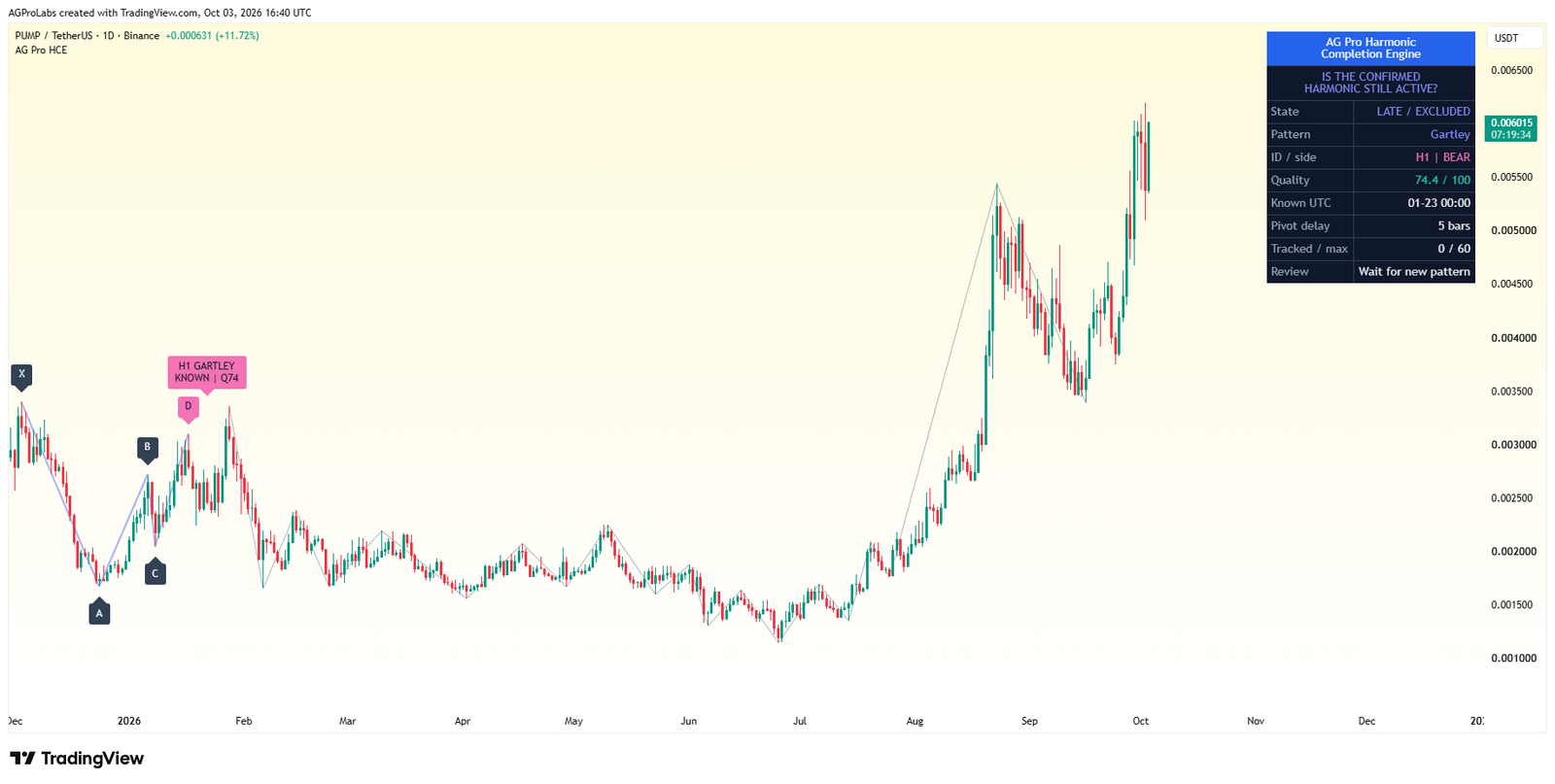
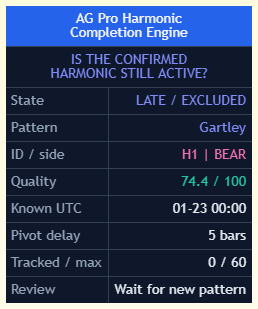
Harmonic pattern review
TradingView Pine Script Workflow
Harmonic Completion Engine [AGPro Series]
5-Year Access, one-time payment. Manual TradingView activation. TradingView and data fees are separate.
Get Access — $149$149.00
Inspect the ratios and reversal zone behind a harmonic pattern.
Inspect confirmed Gartley, Bat, Butterfly and Crab patterns with their measured swing ratios and frozen potential reversal zone. Check current review eligibility alongside failure and two target references.
- One focused workflow
- 5-Year Access · one-time
- Manual TradingView activation
Already paid through Whop? Get TradingView access help
View actual chart & all settings First gallery image: full historical TradingView chart. Second image: historical panel detail. Open the full chart for context; no live signal or performance record.
Manual TradingView activation
Submit the exact TradingView username at checkout. Manual review begins after verified payment; access confirmation follows when activation is complete.
One-time payment. No subscription. Available payment methods are shown before order placement.
Need help before purchase? Ask AGProLabs →
Inside Harmonic Completion Engine
Review the quality and risk frame of a harmonic completion, not just its shape.
Harmonic Completion Engine detects Gartley, Bat, Butterfly and Crab structures from confirmed XABCD swing pivots. It measures the leg relationships, scores how well the best-fitting pattern completes within its ratio tolerances, and maps a potential reversal zone with entry, stop, two target and invalidation references. A 0-100 completion score and Forming, Watch, Ready or Invalid state make the pattern's current condition explicit. The purpose is to support a disciplined harmonic review rather than assume that a recognizable shape must reverse.
Choose with a clear purpose
What this workflow helps you inspect.
For traders reviewing harmonic completion who want to inspect confirmed swing ratios, the potential reversal area and the timing of current eligibility.
- Review the measured XABCD legs behind the pattern name.
- Keep ratio fit separate from structure, reaction and location quality.
- Inspect frozen completion, failure and two target references with current eligibility.
Read the detailed workflow fit
- For discretionary traders who already understand harmonic structures and want a consistent way to evaluate completion, zone location and risk geometry. Reactive, ranging and corrective phases can supply useful structure. Noisy swings, thin liquidity, extreme volatility and gaps can weaken the pivot map and the resulting interpretation.
Inspect interface detail Confirmed XABCD structure with measured ratios
A rough visual resemblance can encourage fitting a pattern to price before its geometry is established.
Completion score and potential reversal zone
Detecting a shape does not explain how closely its ratios fit or where the completion is being evaluated.
Risk references and explicit invalidation
A completed harmonic structure still leaves practical questions about reference levels and loss of validity.
See what each layer contributes.
Open a module to explore its purpose, practical interpretation and boundaries. Examples describe a review process; they are not promises of a trading result.
01Confirmed XABCD structure with measured ratiosA rough visual resemblance can encourage fitting a pattern to price before its geometry is established.
Alternating confirmed pivots form the X-A-B-C-D structure. The engine measures key retracement and projection relationships, including B and D relationships to the X-A leg, and compares them with tolerance bands for the four supported pattern families. The displayed polyline connects the measured points, allowing the score to be reviewed against the actual structure instead of a pattern name alone.
A practical reading
Inspect the XABCD points and completed legs before reading a Ready label as evidence that a particular family has qualified.
Keep in view: Pivot confirmation requires later bars. A pattern drawn across past swings was not fully known at each swing extreme in real time.
02Completion score and potential reversal zoneDetecting a shape does not explain how closely its ratios fit or where the completion is being evaluated.
Confirmed XABCD legs receive a ratio-precision score and a separate composite Quality reading. Quality combines ratio precision, structure, reaction and location, while minimum ratio score governs candidate recording. The PRZ is frozen from the accepted completion context, and current eligibility determines whether the state is Ready to Review, Watch Only or excluded for late knowledge.
A practical reading
Compare a Watch completion with a higher-score Ready example while keeping the same tolerances, rather than changing the settings until both look qualified.
Keep in view: PRZ means potential reversal zone. It is neither a guaranteed turning area nor a calibrated probability of reversal.
03Risk references and explicit invalidationA completed harmonic structure still leaves practical questions about reference levels and loss of validity.
The accepted completion freezes its completion reference, ATR-based PRZ and failure reference with two AD-retracement targets. Current states distinguish Ready to Review, target observations, failure touch, expiry and late/excluded context. The engine shows the current recorded pattern rather than interpreting a close beyond X as its sole invalidation rule.
A practical reading
Read the risk frame and X invalidation alongside completion quality before deciding whether the chart fits your separate planning rules.
Keep in view: The levels are analytical references. The engine does not place orders or ensure that a stop fills, a PRZ holds or either target is reached.
Understand the controls before changing them.
Explore the main controls and control groups below. Read the current TradingView Inputs and tooltips for the available values; choose a consistent configuration before reviewing its results.
Pivot Length
Sets swing sensitivity; higher values produce larger and fewer patterns.
When to adjust
When the structure map should reflect a different swing scale.
Watch for
Longer confirmation windows introduce more delay.
Ratio Tolerance
Defines how far measured leg ratios may deviate from ideal references before rejection.
When to adjust
When specifying strictness for the harmonic study.
Watch for
Wider tolerances admit less exact shapes without proving comparable behavior.
Minimum Score
Sets the quality threshold for recording a qualifying pattern.
When to adjust
When controlling which completions enter the review.
Watch for
A lower threshold expands candidates, not guaranteed opportunities.
Ready Quality
Sets the composite Quality threshold used with the current observation eligibility gates for Ready to Review.
When to adjust
When defining how demanding readiness review should be.
Watch for
Ready remains a structural state, not a trade instruction.
Stop Buffer
Adjusts the protective-stop reference within the risk frame.
When to adjust
When specifying the risk geometry you intend to inspect.
Watch for
The reference is not connected to a broker and cannot prevent gap losses.
PRZ Width and Targets
Control the completion-zone width and the two target references.
When to adjust
When studying a different zone or payoff geometry.
Watch for
Changing the drawings does not establish reversal or target achievement.
Calculation Window
Limits the recent bars processed by the engine.
When to adjust
When balancing processed history with loading work on long datasets.
Watch for
Keep the window recorded when comparing historical reviews; the source does not establish a runtime benchmark.
Display controls
Set theme, panel location, font size and element visibility.
When to adjust
When keeping structure, PRZ and risk references readable.
Watch for
Preserve access to invalidation and confirmation context in compact layouts.
Complete settings reference
Open complete settings reference
Every setting, explained.
Explore each input, its source default, available choices and practical effect before changing your configuration.
The reference shows defaults in the verified source. A preset or saved chart can retain different input values. Chart captures illustrate the interface and are not a live signal or a performance record.
From first look to a documented observation.
- Choose a chart with clear swing structure and sufficient history for the selected pivot length.
- Inspect the confirmed XABCD sequence and supported pattern family, recognizing the confirmation delay.
- Read completion score and PRZ with the ratio-tolerance and threshold settings held consistent.
- Review entry, stop, target and invalidation geometry as a connected framework rather than treating the pattern name as an entry reason.
- Reassess on Invalid or when a newer qualifying pattern becomes active, and retain independent execution and risk controls.
Answers specific to this workflow.
Do confirmed pattern points move afterward?
The public description says a drawn pattern's points do not change. The engine can nevertheless replace the displayed pattern with a newer qualifying structure.
Does it support every harmonic family?
The current product description identifies Gartley, Bat, Butterfly and Crab. No broader family coverage is implied.
Does Ready mean the PRZ must reverse?
No. It means completion quality meets the configured threshold; a completed pattern can still fail or invalidate.
Can a recognizable pattern arrive too late for the current review?
Yes. Confirmed pivots require later bars, and the engine distinguishes current review eligibility from late or excluded completion context. A strong ratio fit alone does not override those timing checks or establish that a reversal remains available.
Product overview and access scope
The Harmonic Completion Engine detects XABCD harmonic structures - Gartley, Bat, Butterfly and Crab - directly from confirmed swing pivots, and turns each one into a structured read.
5-Year Access only. Manual activation for one TradingView username after verified payment.
Product-specific chart proof
Is this harmonic pattern completing cleanly enough to act on - and where is the risk?
Is this harmonic pattern completing cleanly enough to act on - and where is the risk? Harmonic Completion Engine turns that question into a repeatable TradingView review process.
What it organizes
The Harmonic Completion Engine detects XABCD harmonic structures - Gartley, Bat, Butterfly and Crab - directly from confirmed swing pivots, and turns each one into a structured read.
Analytical and educational use only. No auto-trading, broker execution, financial advice or guaranteed outcome.
Complete product intelligence
Understand the workflow before you activate it.
Purpose, methodology, chart language, operating conditions, controls and limitations are presented below so you can evaluate fit before purchase.
System, Purpose & Difference What the workflow exists to solve, what it produces and why its design differs from generic signal tools.
Core Idea
Is this harmonic pattern completing cleanly enough to act on - and where is the risk?
What This Workflow Does
The Harmonic Completion Engine detects XABCD harmonic structures - Gartley, Bat, Butterfly and Crab - directly from confirmed swing pivots, and turns each one into a structured read.
It does three things: it separately records ratio precision and a composite Quality score that combines ratio, structure, reaction and location; it frames an entry, a protective stop, two targets, a reward-to-risk figure and an invalidation level; and it reports a single, clear state so you always know where the setup stands.
It does not predict price, it does not place orders, and it does not claim that a completed pattern must reverse. It is an analytical and visualization layer for traders who already work with harmonic structure.
Purpose & Design Philosophy
Most harmonic tools stop at drawing the shape. They leave the trader to eyeball whether the ratios are clean, where the zone really is, and what the risk would be.
This engine was built to close that gap. It is for the discretionary trader who wants a disciplined, repeatable read on harmonic setups instead of forcing every rough shape into a trade. The design favours patience and clarity: one quality number, one state, one risk frame.
Why It Is Different
Most tools draw a harmonic pattern and stop there.
This script does not just draw a shape and leave you to judge it.
Instead, it scores the completion quality, frames risk and targets, and resolves the setup into a clear act / wait / invalid state - so a harmonic structure becomes a decision, not just a drawing.
Methodology & Chart Language How context is processed and how zones, labels, colors, panels and visual states should be read.
Methodology
- Context detection - confirmed swing pivots are tracked into an alternating X-A-B-C-D structure.
- Reference mapping - the engine measures the key retracement and projection ratios of the legs (notably the B and D Fibonacci relationships to the X-A leg).
- Reaction evaluation - those measured ratios are compared against the tolerance bands for Gartley, Bat, Butterfly and Crab, producing a 0-100 completion score for the best-fitting pattern.
- Visual output - the structure, the PRZ, a centered summary label, the trade levels and the decision panel are rendered.
How to Read the Chart
- Polyline (X-A-B-C-D) - the detected harmonic structure.
- PRZ zone - the potential reversal zone around the completion point (D).
- Centered label - pattern name, completion score and current state, inside the zone.
- Colors - bullish, bearish, neutral and invalidated states each have their own tone.
- Panel - the full decision summary in one place.
Signals, States & Alerts What each visible state represents and when an alert marks a condition that deserves attention.
Signals & States
- WAITING → no qualifying recorded pattern is currently active.
- WATCH ONLY → a pattern is recorded but does not satisfy the current observation eligibility gates.
- READY TO REVIEW → the composite Quality and current eligibility gates support review of the confirmed pattern.
- FAILURE TOUCHED / T1 / FAILED → the fixed failure reference has been touched; T1/T2 observed, expired, late/excluded and data states remain distinct.
These describe structure. They are not buy or sell instructions.
Best Conditions & When to Step Back Where the workflow is most useful, which conditions weaken interpretation and how context changes the reading.
When to Use
- Reactive, ranging or corrective phases where harmonic structure tends to form.
- Works on any timeframe; the 1H to Daily range tends to produce the cleanest harmonic structures and the most readable zones.
When Not to Use
- Thin liquidity, extreme volatility, or news-driven gaps, where swing pivots become unreliable.
- Very noisy, fast chop where structure is not well defined.
Controls, Interface & Practical Workflow The main inputs, visual controls and a repeatable sequence for using the workflow without losing chart clarity.
Key Inputs
- Pivot Length - swing sensitivity; higher values produce larger, fewer patterns.
- Ratio Tolerance - how far measured ratios may deviate from the ideal before a pattern is rejected.
- Minimum / Ready Score - the quality thresholds for recording a pattern and for treating it as Ready.
- Stop Buffer / PRZ Width / Targets - the risk-framing controls.
- Calculation Window - limits the recent bars processed. Changing it can alter the available pivot history and recorded pattern; keep it consistent when comparing reviews.
- Display - theme, panel location, font size, and show / hide toggles.
Boundaries, Limitations & Risk What the workflow does not do, where its outputs can weaken and the risk boundaries every buyer should understand.
What This Workflow Is Not
- It is not a prediction engine.
- It is not financial advice.
- It is not an automated trading system.
- It does not produce guaranteed signals.
Limitations & Transparency
Patterns are confirmed from completed swing pivots, so a structure appears with a lag equal to the pivot length. Once drawn, a pattern's points do not change; however, the engine displays the most recent qualifying pattern and will switch to a newer one as it forms. Timeframe and volatility affect how patterns appear, and harmonic completion never guarantees a reversal.
Risk Disclosure
Trading involves substantial risk of loss and is not suitable for everyone. This script is provided for educational and analytical purposes only and does not constitute financial advice or a recommendation to buy or sell any asset. You remain solely responsible for your own decisions.
5-Year Access & Delivery The access term, payment-to-activation sequence and the TradingView username required for manual delivery.
5-Year Access & Delivery
- New-purchase access: At least five years of access — 1,827 days from purchase. One-time payment; no automatic renewal.
- One TradingView username: submit the exact username during checkout.
- Manual activation: invite-only access is enabled after payment confirmation.
This is an analytical and educational TradingView workflow. It does not connect to a broker, place trades, manage an account, provide financial advice, or guarantee results. Trading involves risk, and every decision remains the user's responsibility.
Before you buy
Clear access. Clear purpose. No signal-shop promises.
Harmonic Completion Engine is delivered as a TradingView Pine Script workflow for structured analysis and chart review. Access is activated manually for the TradingView username submitted at checkout.
- TradingView accessInvite-only access is enabled after payment confirmation.
- Analysis workflowDesigned for context, structure, risk review and visual discipline.
- Not auto-tradingNo broker connection, no account management and no guaranteed outcome.
Product FAQ
Is this a TradingView Pine Script workflow?
Yes. This product is an invite-only AGPro Series workflow for use inside TradingView.
Does it trade automatically?
No. AGProLabs workflows are analytical tools. They do not connect to brokers, place trades or guarantee outcomes.
How is access activated?
Access is activated manually for the TradingView username submitted during checkout after payment confirmation.
Does access include TradingView or paid market data?
No. This purchase provides invite-only access to the selected AGProLabs workflow. It does not include a TradingView subscription or paid exchange data. Check your TradingView plan, available data, chart resources and alert capabilities for your intended workflow before ordering; contact support if unsure.
Related workflows
-

Breaker Block Transition Planner [AGPro Series]
Follow a registered block through its qualified breaker transition and later retest.
AccessSingle workflow 5-Year Access$149.00 View workflow One 5-Year Access option. View details on the product page. -
Auto Fib Structure Planner [AGPro Series]
Review pullback areas, targets and invalidation around a confirmed swing.
AccessSingle workflow 5-Year Access$149.00 View workflow One 5-Year Access option. View details on the product page. -

Structure Failure Recovery Matrix [AGPro Series]
Follow failed structure through recovery, retest and failure acceptance states.
AccessSingle workflow 5-Year Access$149.00 View workflow One 5-Year Access option. View details on the product page. -

Trade Conviction Engine [AGPro Series]
Compare six market checks before judging a setup.
AccessSingle workflow 5-Year Access$149.00 View workflow One 5-Year Access option. View details on the product page.
Compare other premium products (40)
Open a product to review its methodology, interface and access details.
Confirmation & Playbook
- Adaptive Market Playbook [AGPro Series]
- CME Gap Magnet [AGPro Series]
- Confluence Alert Engine [AGPro Series]
- Crypto Rotation Opportunity Matrix [AGPro Series]
- Crypto Setup Planner [AGPro Series]
- Divergence Reversal Decision Matrix [AGPro Series]
- Dynamic Channels Elite [AGPro Series]
- Edge Confidence Gauge [AGPro Series]
- Edge Consistency Gauge [AGPro Series]
- Expected Move Cone [AGPro Series]
- Market Confirmation Engine [AGPro Series]
- Market Tradability Gate [AGPro Series]
- Rejection Block Execution Planner [AGPro Series]
- Seasonal Edge Clock [AGPro Series]
- Support Resistance Continuation Matrix [AGPro Series]
- Trade Edge Profiler [AGPro Series]
- VWAP Acceptance Execution Matrix [AGPro Series]
Defense & Management
Liquidity & Reclaim
Platform Access
Risk & Execution
- Position Scaling Engine [AGPro Series]
- R-Expectancy Surface [AGPro Series]
- Risk of Ruin Engine [AGPro Series]
- Risk Reward Execution Matrix [AGPro Series]
- Target Ladder Confluence Planner [AGPro Series]
- Trade Excursion Engine [AGPro Series]
- Trade Management Planner Elite [AGPro Series]
- Trade Outcome Simulator [AGPro Series]