
Reaction zone lifecycle
TradingView Pine Script Workflow
Institutional Reaction Planner Elite [AGPro Series]
5-Year Access, one-time payment. Manual TradingView activation. TradingView and data fees are separate.
Get Access — $149$149.00
Track how price behaves when it returns to a reaction zone.
Map a qualified reaction area and track how deeply price returns into it. Review later-candle reaction evidence, breaker risk and invalidation pressure as the zone develops.
- One focused workflow
- 5-Year Access · one-time
- Manual TradingView activation
Already paid through Whop? Get TradingView access help
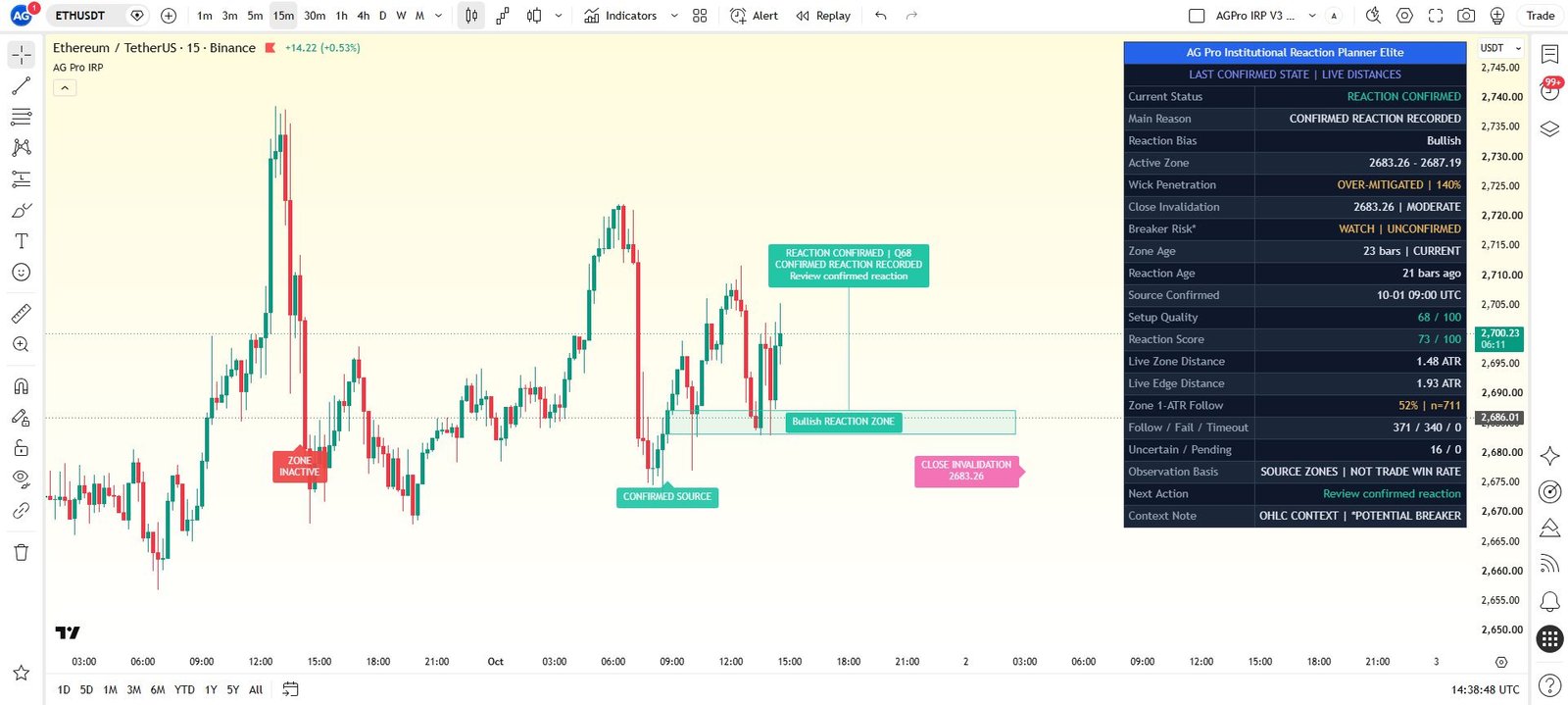
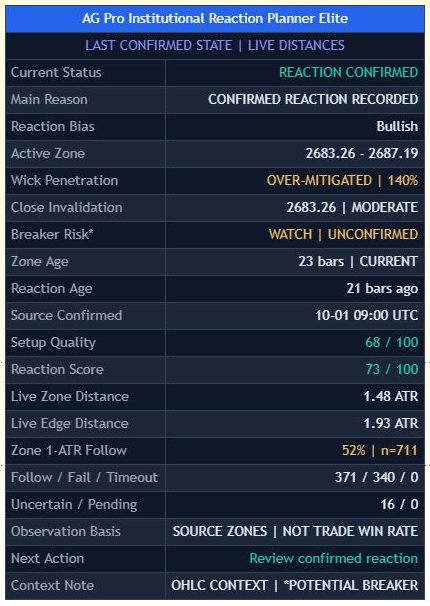
View actual chart & all settings First gallery image: full historical TradingView chart. Second image: historical panel detail. Open the full chart for context; no live signal or performance record.
Manual TradingView activation
Submit the exact TradingView username at checkout. Manual review begins after verified payment; access confirmation follows when activation is complete.
One-time payment. No subscription. Available payment methods are shown before order placement.
Need help before purchase? Ask AGProLabs →
Inside Institutional Reaction Planner Elite
Follow a reaction zone through the return, mitigation and possible loss of validity.
Institutional Reaction Planner Elite brings the management phase of zone analysis into one chart workflow. It identifies qualified reaction candidates, maps the source area and evaluates what happens as price returns: mitigation depth, reaction quality, breaker-transition risk and invalidation pressure. A reaction score, active state and compact dashboard keep the present condition visible instead of leaving an old block as the only reference. The product name describes an analytical approach; the tool does not verify institutional positions or access private order flow.
Choose with a clear purpose
What this workflow helps you inspect.
For traders following the behavior of a mapped reaction zone after detection, including its retest depth, reaction evidence and weakening boundaries.
- Separate source qualification from the selected zone-boundary model.
- Read initial contact, deeper mitigation and later reaction evidence as different events.
- Keep breaker risk and invalidation pressure beside the current reaction state.
Read the detailed workflow fit
- For traders reviewing reaction zones, block retests and changing support or resistance context on charts with meaningful structure. It is useful when a zone's behavior after detection matters more than simply collecting more zones. It is weaker in thin, noisy or news-driven conditions, and it does not replace a directional thesis or independent risk plan.
Inspect interface detail A qualified source and a defined zone model
A highlighted candle can look significant without a clear reason for its inclusion.
Mitigation depth and developing reaction
Every revisit can be mistaken for the same kind of support or resistance test.
Breaker risk and invalidation pressure
A once-useful zone can become a transition area while the original visual label still attracts attention.
See what each layer contributes.
Open a module to explore its purpose, practical interpretation and boundaries. Examples describe a review process; they are not promises of a trading result.
01A qualified source and a defined zone modelA highlighted candle can look significant without a clear reason for its inclusion.
Reaction candidates are reviewed using displacement, candle structure, wick behavior, volatility context and local structure. The selected construction model then maps the active area using body, wick-inclusive or ATR-padded geometry. This separates the reason a candidate qualified from the exact boundaries being monitored, making the resulting zone easier to examine consistently.
A practical reading
Before interpreting a return to the zone, review its source context and construction choice rather than treating the rectangle as self-explanatory evidence.
Keep in view: A qualified reaction area is a rule-based chart reference. It does not establish who traded there or that unfilled institutional orders remain.
02Mitigation depth and developing reactionEvery revisit can be mistaken for the same kind of support or resistance test.
The workflow measures return depth and separates Watch, Reaction Building, Reaction Confirmed and Deep Retest. A confirmation requires the configured completed-candle directional response; with the default later-candle requirement, the initial completed touch cannot confirm itself. Stable Live Display can hold completed-state analytics during a developing candle while explicitly marked price distances remain live.
A practical reading
A deeper revisit with Retest Review deserves a different assessment from a developing shallow reaction, even though both occurred inside the same zone.
Keep in view: Reaction Confirmed is an internal quality state, not a guarantee of a price reversal, continuation or successful entry.
03Breaker risk and invalidation pressureA once-useful zone can become a transition area while the original visual label still attracts attention.
Breaker review examines whether the active area is beginning to behave like a transition context. Invalidation pressure highlights movement against its boundary. The active state, score and next-action context are displayed together with historical labels and alerts, so the trader can recognize that the current zone has a different condition from the one first detected.
A practical reading
When Breaker Review or Invalidation Pressure appears, revisit the zone's role rather than continuing to apply the original reaction assumption unchanged.
Keep in view: The workflow describes observed pressure and rule-based transitions. It cannot guarantee that a zone will hold, fail or reverse its role.
Understand the controls before changing them.
Explore the main controls and control groups below. Read the current TradingView Inputs and tooltips for the available values; choose a consistent configuration before reviewing its results.
Reaction Mode
Chooses Auto, Bullish Only or Bearish Only reaction context.
When to adjust
When focusing the review on one side of a defined thesis.
Watch for
Filtering side does not establish that the selected direction is correct.
Reaction Sensitivity
Controls how strictly a source reaction candidate must qualify.
When to adjust
When defining the selectivity of the zone review.
Watch for
More candidates may include weaker structure as well as more visual activity.
Zone Width Model
Uses body, wick-inclusive or ATR-padded construction.
When to adjust
When choosing which source geometry to track.
Watch for
The zone model changes how later penetration is interpreted.
Breaker Confirmation
Controls how strictly breaker-transition behavior is reviewed.
When to adjust
When specifying the required transition context.
Watch for
A stricter review can delay recognition without guaranteeing a cleaner outcome.
Invalidation Strictness
Adjusts how quickly pressure against the boundary increases.
When to adjust
When defining sensitivity to possible loss of validity.
Watch for
Pressure can fluctuate; an early reading is not a completed failure.
Visual Preset
Controls density and presentation of chart annotations.
When to adjust
When keeping the active reaction readable among other analysis.
Watch for
Visual density is separate from the quality of the zone.
State Label Cooldown
Controls how often historical workflow labels can appear.
When to adjust
When repeated state events crowd the chart.
Watch for
Fewer labels do not mean the underlying market was more stable.
Panel Settings
Adjust visibility, location, theme and text size.
When to adjust
When matching the dashboard to the workspace.
Watch for
Keep mitigation, breaker risk and invalidation readable together.
Complete settings reference
Open complete settings reference
Every setting, explained.
Explore each input, its source default, available choices and practical effect before changing your configuration.
The reference shows defaults in the verified source. A preset or saved chart can retain different input values. Chart captures illustrate the interface and are not a live signal or a performance record.
From first look to a documented observation.
- Select the reaction direction and construction model appropriate to the zone behavior you intend to study.
- Inspect the qualified source and its displacement, wick and structural context before interpreting later state labels.
- As price returns, compare mitigation depth with the developing reaction state and score.
- Keep breaker risk and invalidation pressure in the same review; a positive earlier reaction does not cancel present deterioration.
- Use alerts and state changes as attention markers, then apply your own market, execution and risk analysis.
Answers specific to this workflow.
Does Institutional mean it detects specific institutions?
No. The published method analyzes chart candles, displacement, volatility and structure. It does not identify actual participants or their orders.
What does mitigation tell me?
It describes how deeply price has returned into the mapped zone. The reaction state and invalidation context still need to be read alongside it.
Can I choose how the reaction-zone boundaries are drawn?
Zone Width Model offers body, wick-inclusive and ATR-padded construction. This changes the mapped area being monitored, while source qualification remains a separate question. Compare mitigation and boundary pressure using the chosen geometry.
Product overview and access scope
Institutional Reaction Planner Elite is an invite-only AGPro Series tool built to organize institutional reaction zones into a structured workflow.
5-Year Access only. Manual activation for one TradingView username after verified payment.
Product-specific chart proof
Is the active reaction zone still being respected, mitigated, transitioned into a breaker, or pressured toward invalidation?
Is the active reaction zone still being respected, mitigated, transitioned into a breaker, or pressured toward invalidation? Institutional Reaction Planner Elite turns that question into a repeatable TradingView review process.
What it organizes
Institutional Reaction Planner Elite is an invite-only AGPro Series tool built to organize institutional reaction zones into a structured workflow.
Analytical and educational use only. No auto-trading, broker execution, financial advice or guaranteed outcome.
Complete product intelligence
Understand the workflow before you activate it.
Purpose, methodology, chart language, operating conditions, controls and limitations are presented below so you can evaluate fit before purchase.
System, Purpose & Difference What the workflow exists to solve, what it produces and why its design differs from generic signal tools.
Core Idea
Is the active reaction zone still being respected, mitigated, transitioned into a breaker, or pressured toward invalidation?
What This Workflow Does
Institutional Reaction Planner Elite is an invite-only AGPro Series tool built to organize institutional reaction zones into a structured workflow.
Instead of only marking a block or drawing a support/resistance area, the script evaluates what happens after price interacts with the zone: mitigation depth, reaction state, breaker risk, invalidation pressure, reaction score, and next-action context.
It does not try to predict price direction. It is designed to help traders review reaction behavior with more structure.
Purpose & Design Philosophy
Many block tools stop at detection.
They show where a zone may exist, but they do not clearly explain what is happening after price returns to that zone.
Institutional Reaction Planner Elite was built for the management layer of reaction analysis. It helps the trader separate a clean reaction, a shallow retest, a deep mitigation, a breaker review, and an invalidation-pressure context.
The goal is not to create certainty. The goal is to make reaction behavior easier to review.
Why It Is Different
Most tools focus on one isolated idea:
- rejection blocks
- breaker blocks
- mitigation zones
- institutional candles
- support and resistance areas
This script does not present itself as a paid version of one public block concept.
Instead, it combines the reaction workflow into one planning system:
- source reaction zone
- mitigation depth
- reaction state
- breaker transition
- invalidation pressure
- reaction score
- next action
The difference is not just more labels. The difference is the reaction-planning workflow.
Methodology & Chart Language How context is processed and how zones, labels, colors, panels and visual states should be read.
Methodology
- Reaction Source Detection
The script identifies qualified bullish or bearish reaction candidates using displacement, candle structure, wick behavior, volatility context, and local structure.
- Zone Mapping
It maps a compact reaction zone from the active source context.
- Mitigation Evaluation
It measures how deeply price has returned into the active reaction zone.
- Breaker / Invalidation Review
It evaluates whether price is respecting the zone, pressing through it, or creating a breaker-transition context.
- Visual Output
It renders the active zone, mitigation label, reaction score, state labels, alerts, and a compact AGPro dashboard.
How to Read the Chart
Reaction Zone
The highlighted zone shows the active reaction area being reviewed.
Mitigation
The mitigation label shows how deeply price has returned into the active zone.
Reaction State
The state label identifies the current workflow context, such as WATCH, REACTION CONFIRMED, RETEST REVIEW, BREAKER REVIEW, or INVALIDATED.
Breaker Risk
Breaker Risk shows whether the zone is beginning to behave like a transition area.
Invalidation
Invalidation pressure shows whether price is pushing beyond the zone boundary.
Panel
The panel summarizes reaction bias, active zone, mitigation, reaction state, breaker risk, invalidation, reaction score, and next action.
Signals, States & Alerts What each visible state represents and when an alert marks a condition that deserves attention.
Signals & States
- WATCH → the zone exists, but no stronger reaction state is active
- REACTION BUILDING → price has returned to the zone and response is developing
- REACTION CONFIRMED → the script detects a stronger reaction-quality context
- DEEP RETEST → mitigation depth calls for closer review
- BREAKER RISK → price behavior suggests transition risk, without proving a completed role reversal
- INVALIDATION PRESSURE → price is pressuring the reaction boundary
Best Conditions & When to Step Back Where the workflow is most useful, which conditions weaken interpretation and how context changes the reading.
When to Use
Institutional Reaction Planner Elite can be useful when reviewing:
- reaction zones
- support and resistance responses
- block retests
- breaker-transition areas
- mitigation behavior
- institutional candle reactions
- swing reaction structure
- multi-timeframe reaction context
When Not to Use
This tool is weaker when price action is extremely noisy or when there is no meaningful reaction context.
Avoid relying on it in isolation during:
- very low-liquidity conditions
- extreme news-driven volatility
- random low-timeframe chop
- charts where the reaction zone is not structurally meaningful
- situations where the user expects automatic trade decisions
Controls, Interface & Practical Workflow The main inputs, visual controls and a repeatable sequence for using the workflow without losing chart clarity.
Key Inputs
Reaction Mode
Controls whether the script reviews Auto, Bullish Only, or Bearish Only reaction context.
Reaction Sensitivity
Controls how strict the reaction source qualification should be.
Zone Width Model
Controls whether the reaction zone uses body, wick-inclusive, or ATR-padded construction.
Breaker Confirmation
Controls how strictly breaker-transition behavior is reviewed.
Invalidation Strictness
Controls how quickly invalidation pressure increases.
Visual Preset
Controls chart density and presentation style.
State Label Cooldown
Controls how often historical workflow labels can appear.
Panel Settings
Control panel visibility, location, theme, and text size.
Boundaries, Limitations & Risk What the workflow does not do, where its outputs can weaken and the risk boundaries every buyer should understand.
What This Workflow Is Not
Institutional Reaction Planner Elite is not:
- a prediction engine
- a financial advice tool
- an automated trading system
- a guaranteed signal system
- a one-click buy/sell indicator
- a direct paid clone of a public block script
- a replacement for trader judgment
Limitations & Transparency
Market conditions matter.
Timeframe differences can change visual density and state behavior. Volatility can expand or compress reaction zones. Low-liquidity assets can create noisy state shifts. Sensitivity settings can change how often zones appear.
The script is rule-based. It organizes reaction information; it does not know future price movement.
Risk Disclosure
Trading involves risk.
All outputs from this script are for educational and analytical purposes only. They should not be interpreted as financial advice, investment advice, or guaranteed trading outcomes.
Users remain fully responsible for their own decisions, risk management, and execution.
5-Year Access & Delivery The access term, payment-to-activation sequence and the TradingView username required for manual delivery.
5-Year Access & Delivery
- New-purchase access: At least five years of access — 1,827 days from purchase. One-time payment; no automatic renewal.
- One TradingView username: submit the exact username during checkout.
- Manual activation: invite-only access is enabled after payment confirmation.
This is an analytical and educational TradingView workflow. It does not connect to a broker, place trades, manage an account, provide financial advice, or guarantee results. Trading involves risk, and every decision remains the user's responsibility.
Before you buy
Clear access. Clear purpose. No signal-shop promises.
Institutional Reaction Planner Elite is delivered as a TradingView Pine Script workflow for structured analysis and chart review. Access is activated manually for the TradingView username submitted at checkout.
- TradingView accessInvite-only access is enabled after payment confirmation.
- Analysis workflowDesigned for context, structure, risk review and visual discipline.
- Not auto-tradingNo broker connection, no account management and no guaranteed outcome.
Product FAQ
Is this a TradingView Pine Script workflow?
Yes. This product is an invite-only AGPro Series workflow for use inside TradingView.
Does it trade automatically?
No. AGProLabs workflows are analytical tools. They do not connect to brokers, place trades or guarantee outcomes.
How is access activated?
Access is activated manually for the TradingView username submitted during checkout after payment confirmation.
Does access include TradingView or paid market data?
No. This purchase provides invite-only access to the selected AGProLabs workflow. It does not include a TradingView subscription or paid exchange data. Check your TradingView plan, available data, chart resources and alert capabilities for your intended workflow before ordering; contact support if unsure.
Related workflows
-
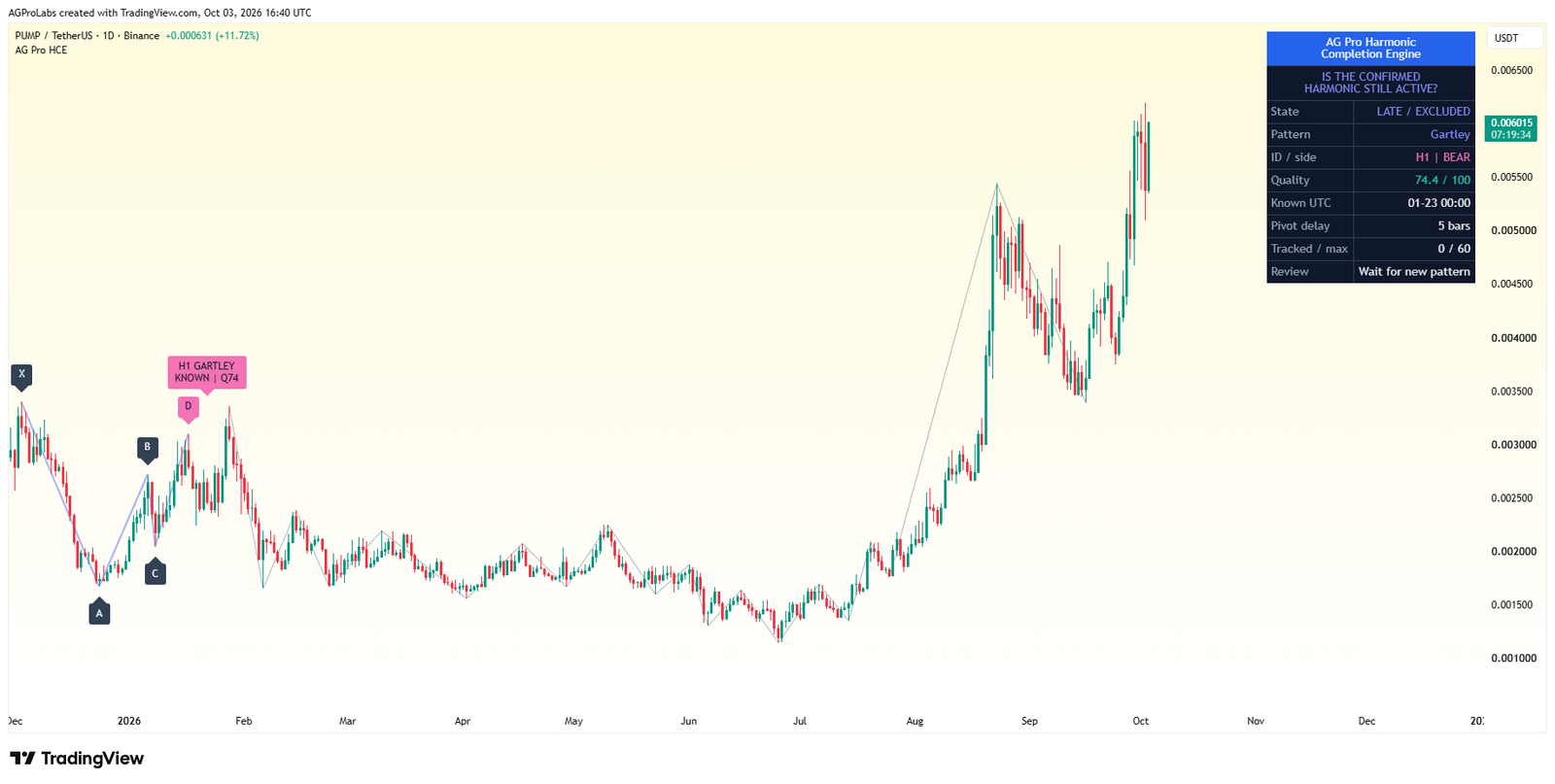
Harmonic Completion Engine [AGPro Series]
Review harmonic ratios, the potential reversal zone and current timing together.
AccessSingle workflow 5-Year Access$149.00 View workflow One 5-Year Access option. View details on the product page. -
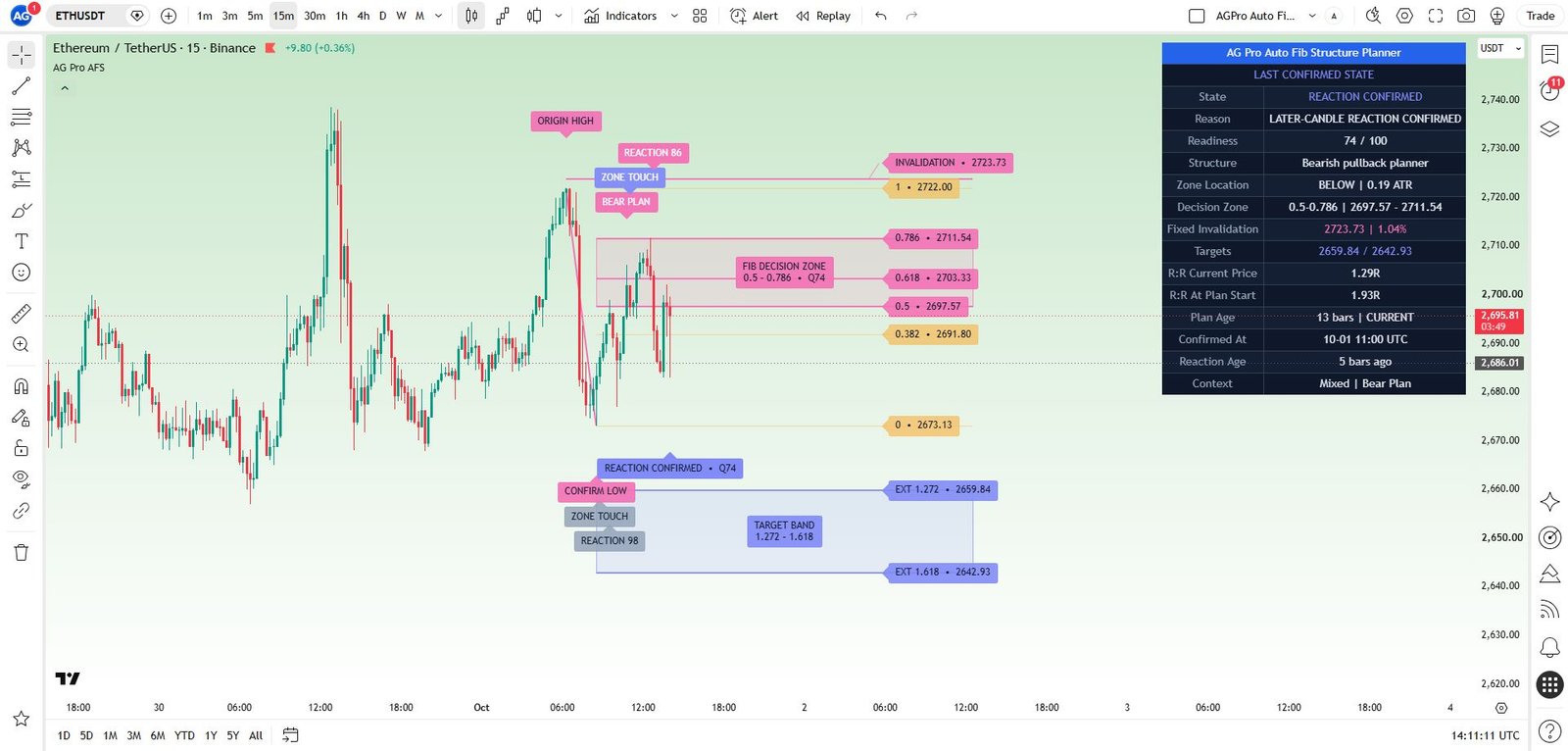
Auto Fib Structure Planner [AGPro Series]
Review pullback areas, targets and invalidation around a confirmed swing.
AccessSingle workflow 5-Year Access$149.00 View workflow One 5-Year Access option. View details on the product page. -

Breaker Block Transition Planner [AGPro Series]
Follow a registered block through its qualified breaker transition and later retest.
AccessSingle workflow 5-Year Access$149.00 View workflow One 5-Year Access option. View details on the product page. -

Trade Conviction Engine [AGPro Series]
Compare six market checks before judging a setup.
AccessSingle workflow 5-Year Access$149.00 View workflow One 5-Year Access option. View details on the product page.
Compare other premium products (40)
Open a product to review its methodology, interface and access details.
Confirmation & Playbook
- Adaptive Market Playbook [AGPro Series]
- CME Gap Magnet [AGPro Series]
- Confluence Alert Engine [AGPro Series]
- Crypto Rotation Opportunity Matrix [AGPro Series]
- Crypto Setup Planner [AGPro Series]
- Divergence Reversal Decision Matrix [AGPro Series]
- Dynamic Channels Elite [AGPro Series]
- Edge Confidence Gauge [AGPro Series]
- Edge Consistency Gauge [AGPro Series]
- Expected Move Cone [AGPro Series]
- Market Confirmation Engine [AGPro Series]
- Market Tradability Gate [AGPro Series]
- Rejection Block Execution Planner [AGPro Series]
- Seasonal Edge Clock [AGPro Series]
- Support Resistance Continuation Matrix [AGPro Series]
- Trade Edge Profiler [AGPro Series]
- VWAP Acceptance Execution Matrix [AGPro Series]
Defense & Management
Liquidity & Reclaim
Platform Access
Risk & Execution
- Position Scaling Engine [AGPro Series]
- R-Expectancy Surface [AGPro Series]
- Risk of Ruin Engine [AGPro Series]
- Risk Reward Execution Matrix [AGPro Series]
- Target Ladder Confluence Planner [AGPro Series]
- Trade Excursion Engine [AGPro Series]
- Trade Management Planner Elite [AGPro Series]
- Trade Outcome Simulator [AGPro Series]